

Best Home Studio Microphones for Recording Vocals
Although today’s music creation software offers us a wide variety of virtual instruments, in any space dedicated to music production, whether professional or home studio, having one of the best microphones for home studio will be a differential tool for recording vocals at home and will always occupy a central place in our creative space.
One of the questions we get asked the most by the artists we collaborate with in our recording studio when producing songs online is regarding which microphone we recommend buying to record vocals professionally at home and send us the tracks, in order to achieve the best result in the vocal production of their songs.
In this article about recording studio equipment from GuitarRec, we offer you an analysis of the home studio microphones that, due to their quality and price, and their use by producers around the world, seem most interesting to us. A list that we hope will be useful when deciding which one best suits the needs of your way of producing and recording at home.
Let’s get to our analysis!
List of Best Microphones for Home Studio and Music Production
1- Shure SM7B (Dynamic microphone)

This dynamic microphone has a lot of history behind it (does Michael Jackson’s Thriller ring a bell?) and has been a huge sales success especially since the rise of podcasting as a mass phenomenon.
It is especially recommended for recording vocals (it was originally designed for broadcast and radio, and has become the standard for professional podcasting) and can be your best ally if your style leans towards rock, metal, trap or hip hop, where it brings a direct and aggressive character to the voice. Currently the Shure SM7B is one of the most used microphones for recording in home studios and portable music production studios.
It offers clarity and a low level of external noise like few others, comes with a pop filter (double) included and with its characteristic mount. For these reasons it is also one of the favorites in radio stations, voice-over recording, podcasters and youtubers. Without a doubt, it is one of the best microphones for recording vocals. Being very directional and dynamic, you will prevent sound from leaking from your studio headphones during vocal recordings.
- Dynamic microphone widely used for vocals
- Cardioid polar pattern
- Sensitivity: -59.0 dB (1.12 mV/Pa)
- Presence boost (mid-boost) and low-cut switch
- Includes mount, connector cap and windscreen
2- AKG c214 (Condenser microphone)

We continue our analysis with a large-diaphragm condenser microphone, the little brother of the legendary AKG c414, which is a fundamental piece in any professional studio.
It is a precise and realistic microphone for recording. Ideal for capturing all the nuances of a performance, whether vocal or instrumental. On the downside, it is delicate, so if our recording space is not well conditioned, this will be reflected in our takes. Remember that condenser microphones require a preamp or mixing desk with Phantom power (+48v).
Although it can be used in different styles, it is very suitable as a professional vocal recording microphone for singer-songwriters, acoustic guitars or more vintage styles.
Its build quality and features take it more into the professional arena, but its tight price, for what it offers and knowing that it features the same capsule as the 414 although without being able to choose between polar patterns, makes it a more than interesting option for home studio if you want to have a powerful tool for your recordings.
- Condenser microphone for vocals or instruments
- Frequency response: 20 Hz – 20 kHz
- 20 dB pad attenuator in case you record something louder
- Requires 12 – 52V phantom power
- Includes clip, case and windscreen
3- Audio-Technica AT4040 (Condenser microphone)

Another large-diaphragm condenser microphone we recommend, is an “all-terrain”. A companion that will follow you without complaint on any adventure in your new home studio.
The Audio-Technica AT4040 SM is an excellent option for recording vocals professionally in the studio.
This microphone stands out for its robust construction and great versatility, being suitable for both vocal and instrument recording. Although it doesn’t have the legendary aura of some competitors, it offers a very crystalline and clear sound response, which makes it perfect for experimenting in home studio recordings or professional project studios, especially for vocals.
It is one of the most used microphones in home studios and project studios, both in professional vocal recordings and in instruments that need a level of detail up to the standard of a good condenser microphone. It has one standout aspect: the 15-year warranty offered by the brand.
- Large-diaphragm capsule offering a clear and detailed response.
- Cardioid polar pattern that captures sound in a focused way, ideal for recording vocals and isolating unwanted noise.
- 80 Hz high-pass filter, useful for attenuating unwanted low frequencies.
- Includes AT8449 shock mount and hard case.
If you work across different styles and are looking for a main microphone for recording vocals, the AT4040 can be a great investment and a leap in quality for your home studio.
4- Rode NT1-A (Condenser microphone)

The Rode NT1-A Complete Vocal Recording is one of the most recommended condenser microphones for those looking for a quality solution at an affordable price. Without a doubt, it has become a standard and one of the best microphones for home studio, especially for those starting to record semi-professionally. This set includes the large-diaphragm NT1-A microphone, a shock mount, a pop filter, a 6-meter XLR cable and a protective cover, making it an ideal option for recording vocals and other acoustic instruments in a home studio. With extremely low self-noise and a frequency response from 20 Hz to 20 kHz, it is known for its warmth and clarity in vocal recordings.
Key technical specifications:
- 1″ diaphragm with cardioid polar pattern
- Frequency range: 20 Hz – 20 kHz
- Maximum SPL: 137 dB
- Output impedance: 100 Ohm
- Phantom power: 48V
This microphone, perfect for music production, stands out for its versatility and is perfect for both vocals and instrument recordings, offering a warm and rounded sound that compares favorably with more expensive microphones. An excellent gateway to professional audio recording from home. Without a doubt, the Rode NT1 is a current standard in project home studios around the world.

5- Aston Microphones Origin (condenser)

The Aston Microphones Origin is a large-diaphragm condenser microphone that has become a standard in recording studios and home studios around the world. Recognized for its robustness, attractive design and excellent sound quality, this microphone offers a natural and balanced response in vocal and acoustic instrument recordings. A quality microphone to capture the signal professionally and thus improve the sound in the tuning and mixing of vocal tracks with the instrumental. Its design includes an internal shock absorption system to protect the capsule, a built-in pop filter and the ability to switch to a -10 dB pad, making it versatile and capable of handling loud sound sources without distortion.
Key features:
- Cardioid polar pattern for focused and precise pickup.
- Frequency response: 20 Hz – 20 kHz.
- Pad switch: -10 dB / 0 dB.
- Maximum SPL: 127 dB.
- 80 Hz high-pass filter to remove unwanted frequencies.
6- Universal Audio SD-1 (dynamic)
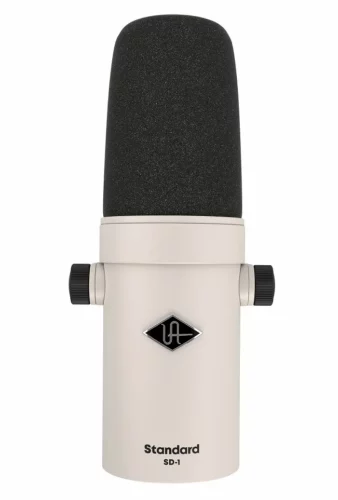
The Universal Audio SD-1 is a dynamic microphone oriented towards recording vocals professionally in the studio, voice-over and podcast, and a clear alternative to the Shure SM7B. It offers a controlled vocal sound with good presence, with a robust design and practical solutions designed for content creators and modern studios. Universal Audio’s experience shows both in the sonic character and in its integration with the Apollo ecosystem of free plugins and paid ones offered by one of the most powerful brands in terms of music production in professional and project studios.
Key features:
- Dynamic microphone for studio vocals and podcast.
- Cardioid polar pattern for focused pickup.
- Frequency response: 50 Hz – 16 kHz.
- Switchable 200 Hz low-cut filter.
- Presence boost for greater vocal clarity.
- Built-in pop filter and mount.
- Integration with presets for Universal Audio Apollo.
7- Neumann TLM 103

If you’re already clear that you’re going to dedicate a lot of time to recording vocals and producing music, you may want to start by making an important leap in quality. Neumann is one of the main brands in professional studios (in our recording studio in Barcelona we have a U87AI as the main vocal microphone for years now), but in this list we recommend one that is widely used in project studios and perhaps the one most used in high-end home studios: the Neumann TLM 103. By inheriting the capsule design of its bigger brother, this condenser microphone offers a crystalline sound, super transparent and with practically zero background noise. It doesn’t matter what you put in front of it; the level of detail in your vocal or instrument recordings will be totally professional.
Key features:
- Large-diaphragm condenser microphone for studio.
- Capsule design based on the legendary Neumann U 87.
- Cardioid polar pattern.
- Extremely low self-noise, ideal for soft vocals or detailed acoustic recordings.
- Wide frequency response: 20 Hz – 20 kHz.
- Requires Phantom power (+48V).
- The Studio Bundle includes the original Neumann EA 1 elastic anti-vibration shock mount (essential for this type of microphone).
Essential accessory for your studio microphone: Pop Filter
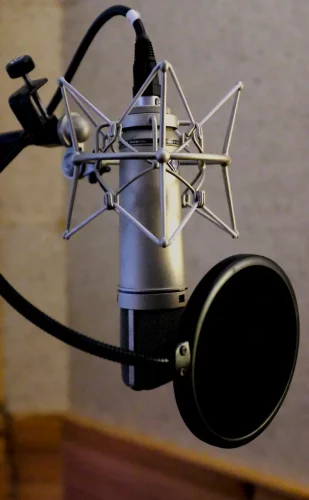
When recording vocals, the blast of air generated by the consonants P and B produces sudden and uncontrolled noises in the low frequencies, known as plosives. These peaks are very difficult to fix in the mix and can ruin a good take.
The pop filter is an indispensable accessory in any home studio to avoid this problem. It is placed between the singer’s mouth and the microphone, and acts as a physical barrier that disperses the blast of air before it reaches the capsule, without hardly affecting the sound of the voice.
There are two main types:
- Fabric (nylon): the most common and affordable. They usually come in double layer for greater effectiveness. Slightly warmer tone.
- Metal: more durable, easy to clean (important if several people are recording) and with a more transparent response in the high end. Somewhat more expensive.
Some microphones already incorporate their own internal filter and don’t need an additional one. The best-known case is the Shure SM7B, which comes with a foam specifically designed for this purpose (and includes a second, denser A7WS foam for voices very close to the mic). Other microphones, depending on the pack you choose, may include pop filter, shock mount or stand as extra accessories, so it’s worth checking what each one comes with before buying separate accessories.
If your microphone is a condenser (Neumann, Rode, AKG, etc.), you will definitely need an external pop filter. Look for options with double layer of fabric or metal, with a flexible arm that easily adjusts to any microphone stand. At GuitarRec we receive tracks for our music production services, and we assure you that the final result of many vocals would be infinitely better if they had taken care of this small detail when recording.
The studio microphone is not the only thing you have to think about
We also want to remind you that it is very important to have a microphone preamp or an external audio interface (with XLR/canon inputs and phantom power for condenser microphones) in accordance with the quality of the microphone and above all to have good acoustic treatment in the room where the recordings take place. This will prevent the sound of the room from interfering with unwanted reverberations in the quality of the voice or audio recorded through the microphone.
Investing in a good microphone stand (support) is also a great decision. Not only for the safety of your equipment, but also to prevent the arm from losing strength after a short time and the microphone from dropping during the middle of a session.
Conclusion
To finish, if you still haven’t decided, take your time, go over the options and choose the one that best suits your needs or, simply, the one that excites you the most. You’ll surely get it right! Oh, and once you’ve decided on one, remember to take very good care of your new friend: you’re going to spend a lot of time together. Enjoy!
*This article contains affiliate links that help us create our site. Don’t worry: the price you pay is the same! If you buy something through these links, we will receive a small commission. Thank you for your support!

Manel Guerrero
Singer-songwriter, composer and producer based in Barcelona. After two albums with Malaventura as guitarist and songwriter, he has released two indie folk EPs (recorded and mixed at our studio in Barcelona), influenced by The Beatles and Elliott Smith. He created the tribute Plastic Ono Man — A Tribute to John Lennon/Plastic Ono Band, a full reinterpretation of Lennon’s album, and has composed soundtracks for film and video games.
Besides occasionally writing articles for our blog, Manel has been a regular collaborator for years on the studio’s online music productions as an arranger and vocalist, bringing his own perspective as a songwriter.
More info on his Instagram and his music on Spotify.