

Top 5 Audio Interfaces for Home Studio
If there’s one piece of gear that sits right at the heart of any music production studio, it’s the audio interface or sound card for home studio. This is what lets us convert the analog signal from our recordings into digital data and vice versa, while also giving us all the inputs and outputs we need to record with a mic or monitor audio from our computer, improving latency (the delay) while recording.
Since on a lot of the online music productions we run at GuitarRec the vocal tracking is done by our songwriter/artist clients themselves, we often get asked which audio interface or sound card to go for. So in this article we’re going to focus on five little beasts (plus a few bonus picks we’ve been adding as they’ve come out since we first wrote this piece) that offer great performance and plenty of possibilities, both technical and creative, with a solid number of inputs and outputs for home studio recording.
Before getting into the details, we want to clear up one thing:
What’s the best audio interface for recording guitar?
If you’re a guitarist looking for the perfect interface for your home studio, we’ve got good news: every single audio interface in this list includes an essential feature for guitar players: a HI-Z high-impedance input.
That means you can plug your electric guitar or bass straight into any of these interfaces to set up a home recording studio without needing pedals or DI boxes in between. Your guitar signal will be captured with all its harmonic and dynamic richness, ready to process with your favorite plugins.
That said, there’s an important nuance whether you’re recording guitars, vocals or any other instrument: the quality of the converters makes a real difference. While any interface on this list will do the job to get you started, the higher-end options (with better converters, which are what digitize the audio on the way in and back out on the way out) will capture more detailed nuances and give you a lower noise floor. Basically: the better the interface, the better the recording quality from day one.
At our studio we specialize in online guitar recording, and we can promise you any of these interfaces will do the job for plugging in your guitar — but if your budget allows, investing in better converters will always show up in the final result of the recording.
Let’s get into the list!
Best sound cards or audio interfaces for home studio production
1. Yamaha URX22
Yamaha has been building mixing consoles and preamps for decades, and with the URX series it has poured all that experience into a desktop format. The first thing that surprises you when you take it out of the box is the 4.3-inch touchscreen with physical knobs: you can set everything up from the unit itself, without having to wrestle with your computer.
Yamaha URX22, the interface that handles like a miniature mixing desk
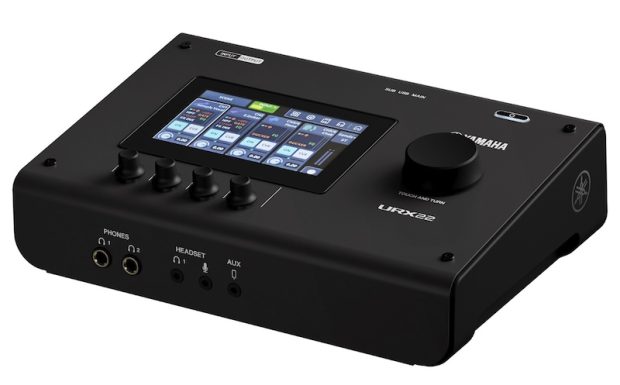
It’s a 4-in/2-out USB-C unit with 32-bit/192 kHz resolution and two URX preamps offering 78 dB of gain range and +48 V phantom power. One of the combo inputs switches to Hi-Z so you can plug your guitar in directly, and there are two USB ports (MAIN and SUB) plus an AUX input and two headphone outputs, which makes it perfect for recording with a phone or tablet and for two-host podcasts.
Its big selling point for guitarists is the internal DSP: amp simulator, REV-X reverb, compressor, gate and EQ, all monitored latency-free. If you need more channels, the URX44 goes up to four mic inputs, and the URX44V adds an HDMI input with video capture and pass-through.
2. Behringer UPhoria UMC204HD
If there’s one brand that seems determined to keep surprising us, it’s Behringer. They give us a small unit that lacks for nothing at a very, very low price. On top of that, as a calling card, its built-in mic preamps are designed by the legendary Midas brand, which Behringer acquired a while back.

The UPhoria UMC204HD is a compact, solid unit, USB-powered (no separate power supply needed). With two XLR/jack combo inputs and four outputs, MIDI in and out, and a dedicated headphone output with its own knob, connectivity-wise it has everything you need, nicely laid out in a very small footprint.
It can record at 24 bit / 192 kHz and includes phantom power for condenser mics. We’d love to find something bad to say, but at that price this interface leaves us with no arguments.
3. Focusrite Scarlett 2i2 4th Generation
Without a doubt, one of the best-selling audio interfaces of recent years. Focusrite has nailed it on design, features and price. The Scarlett range reaches its 4th generation with a modern, clean-looking interface (you won’t find many knobs or buttons on it) but fully functional.

With a USB-C port, compatible with Windows and Mac, and fitted with two Scarlett preamps that have received great reviews for being clean and precise — something unusual at this price point. On top of that, the “Air” function adds a really interesting touch, letting you subtly tweak the preamp’s frequency response to shape the sonic character of the best home studio microphones and other instruments going in through the line inputs.
The Focusrite Scarlett, across any of its generations, has always had a love-hate relationship with its users: it’s the gateway into the home studio world for a huge percentage of music production lovers, but it’s also the interface those same users end up replacing after a while, looking for preamps with more character. Even so, as a first interface it’s still a solid choice: it does the job, it sounds clean, and it lets you start recording at home with no fuss.
4. Audient iD14 MKII
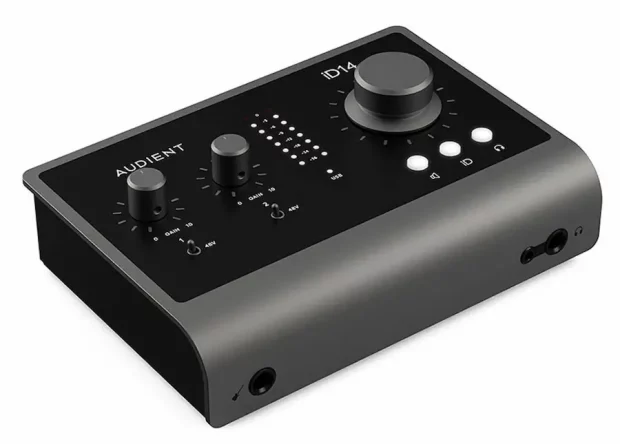
Audient is a British brand that’s been making preamps and studio consoles since the early days of home studio, and we’re hearing more and more about it lately. And with good reason: the iD14 MKII packs the same Class A preamps they use in their professional analog consoles. At around €220, it’s the middle step that was missing between the Scarlett and the jump up to a Universal Audio.
It has two combo inputs (accepting both XLR for mic and jack for line) with 58 dB of gain, an instrument input with a JFET stage designed for guitar amp simulators, four line outputs (for two pairs of monitors) and two outputs for connecting studio headphones. Full metal build, USB-C and USB bus-powered (no separate power supply). We want to highlight its optical ADAT input, which lets you expand up to 10 channels down the line if you end up wanting to record drums or several musicians at the same time (although if you already know your production journey is in it for the long haul, we’d suggest you keep looking at the other options in this list).
Records at 24 bit / 96 kHz with high-dynamic-range converters. If you’re after an interface you won’t need to swap out for a long time, this is one of the most sensible recommendations on this list.
5. Universal Audio Apollo Twin X and the new Volt

We’re now jumping up a considerable step in terms of price range, but Universal Audio delivers quality at a professional level. The Apollo Twin X (the evolution of the mythic Apollo Twin MKII) features two preamps with Unison technology, which emulate some of the most iconic preamps in history: Neve, API, Manley, SSL… These virtual preamps are handled internally in the interface thanks to the built-in DSP processors (hence the “Duo” in Duo Core), which lets you monitor effects with virtually no latency while recording and save CPU on your computer.
The Apollo Twin X starts at around €900 in the Essentials+ edition and can go over €1,000-1,200 depending on the plugin pack it comes with (Studio+ or Heritage). That said, from GuitarRec we can tell you that UA’s plugins are some of the best out there, especially the compressors and reverbs, and we use them constantly in our online mixing and mastering service. If your goal is to get serious with music production, this interface will stick with you for a long time and make you very happy.
Universal Audio Volt 2
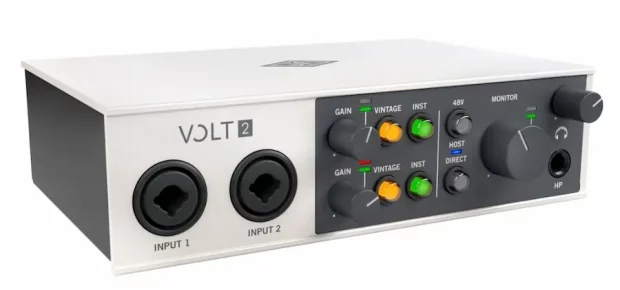
If the jump to an Apollo is out of budget, UA has the Volt series, designed exactly for people starting to set up a project studio with intentions of going pro. The preamps keep the classic UA sound inspired by the 610 preamps, with a “Vintage” mode switch that adds analog character and saturation — really useful especially for vocals.
The only relevant difference compared to the Apollo is that the Volts don’t include onboard DSP, so you can’t load UAD plugins directly on the interface itself. But a while back UA launched UAD Spark, which lets you run those same plugins natively (via subscription) with any interface on the market, so that gap is covered. The Volt 2 has 2 ins and 2 outs, the Volt 4 scales up to 4×4 so you can hook up two pairs of monitors, and the Volt 276 adds an integrated analog compressor built for vocals. A really solid alternative to the other interfaces we’ve shown you in this list.
6. RME Fireface UCX II and Babyface Pro FS
RME might ring fewer bells if you’re just starting out, but we can’t skip it. Their interfaces and preamps are a hidden gem inside some of the best home studios and pro studios in the world. At our Barcelona recording studio we’ve been trusting this brand for years for the quality of its preamps, the precision of its converters and the legendary robustness of its drivers (both on Mac and PC).
RME Fireface UCX II
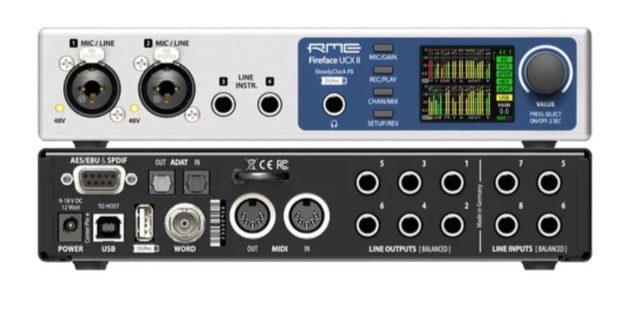
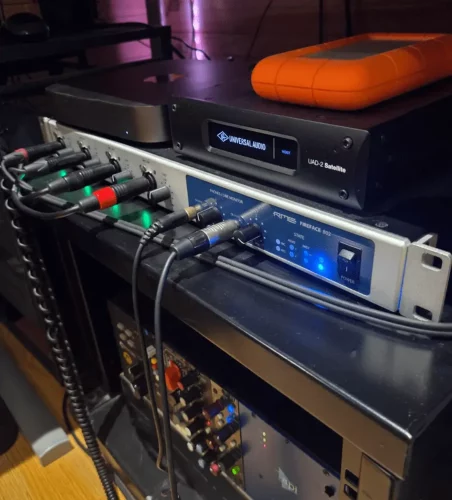
The evolution of the classic UCX comes in a half-rack (9.5″) format with USB 2.0 connectivity. Despite its compact size, it offers a stunning 20 channels of input and output (including ADAT, SPDIF and AES/EBU connections), giving you huge versatility for any studio situation.
This second generation comes with some major upgrades over its predecessor:
- Color display and SteadyClock FS: It comes with a front panel display to check levels at a glance and RME’s latest clock technology to deliver absolutely transparent 24-bit / 192 kHz audio conversion.
- DURec (Direct USB Recording) function: Hands down, one of its standout features. It lets you record all inputs and outputs directly to a USB drive or external hard drive (up to 2 TB) plugged into the back, acting as a standalone recorder with no computer needed.
Of course, it keeps the features that made the original great: an onboard DSP processor that lets you monitor native effects (like reverb, EQ or compression) without latency while recording, and the extremely powerful TotalMix FX software, a virtual mixer that allows any signal routing you can imagine. It also has Class Compliant mode, which lets you plug it straight into an iPad, and it can run in Stand-Alone mode (as an independent mixer without a computer).
RME Babyface Pro FS
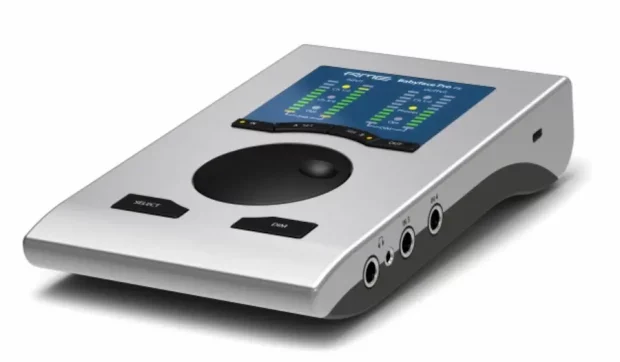
If you’re drawn to RME’s crystal-clear sound and extreme reliability but want something more portable (and a bit cheaper than the desktop Fireface series), we suggest checking out their proven model: the RME Babyface Pro FS. For build quality and driver stability, it’s one of the best portable audio interfaces for producing music in a home studio and for taking your professional sound wherever you go.
Now let’s move on to a few bonus picks of interfaces we find interesting:
(extra) 7. MOTU M2

The MOTU M2 is a USB-C audio interface that has become really popular among producers and musicians thanks to its excellent sound quality in a compact and functional design. MOTU is a brand that’s been around since the early days of home studio music production, putting out high-quality gear, especially in the Mac environment (their DAW Digital Performer is one of the most veteran on the market). This model is compatible with Mac, Windows and iOS, and features two combo inputs with preamps, two balanced line outputs and ESS Sabre32 Ultra converters, the same technology used in high-end gear, allowing it to deliver top-tier audio quality in both recording and playback.
It stands out for the stability of its drivers (one of MOTU’s historical strengths) and for including a color LCD with detailed meters for all inputs and outputs, something unusual at this price range. It also has MIDI in and out and a loopback function, really handy if on top of your home studio you plan to use it for streaming or podcasting. Without a doubt a good option to get started in home recording with a brand that’s more than established in professional audio interfaces.
(extra) 8. SSL 2 MKII and SSL 2+

The SSL 2 is a USB-C audio interface that stands out for bringing the quality and prestige of Solid State Logic, a legendary name in the world of pro recording studios, into a compact and accessible format for home studios. With two inputs fitted with SSL preamps and two outputs, it keeps the warmth and clarity the brand is known for. An added bonus is the “Legacy 4K” button, which emulates the famous analog character of the SSL 4000 series consoles, adding brightness and presence to your recordings.
The SSL 2+ MKII keeps the same audio specs but adds more connectivity: four outputs, MIDI in and out and dual headphone outputs with independent mixes. A great option if you need to hook up two pairs of studio monitors or record someone else with their own monitoring.
Don’t hesitate to invest as much as you can afford in your new studio partner. The external sound card or audio interface is one of the main elements to produce music professionally with any software-based DAW recording system. Enjoy the ride!
*This article contains affiliate links that help us keep our site running. Don’t worry: the price you pay is the same! If you buy something through these links, we’ll receive a small commission. Thanks for your support!

Manel Guerrero

Singer-songwriter, composer and producer based in Barcelona. After two albums with Malaventura as guitarist and songwriter, he has released two indie folk EPs (recorded and mixed at our studio in Barcelona), influenced by The Beatles and Elliott Smith. He created the tribute Plastic Ono Man — A Tribute to John Lennon/Plastic Ono Band, a full reinterpretation of Lennon’s album, and has composed soundtracks for film and video games.
Besides occasionally writing articles for our blog, Manel has been a regular collaborator for years on the studio’s online music productions as an arranger and vocalist, bringing his own perspective as a songwriter.
More info on his Instagram and his music on Spotify.