

Top 5 Studio Headphones for Music Production
Studio headphones are an essential tool in the world of music production. Choosing the best cans (or headphones) for recording, monitoring and even mixing music in a portable setup, a home studio or a professional recording studio is one of the most important decisions you’ll make, and one of the ones that will most impact the final sound of your productions.
In this article we want to recommend some of the best studio headphones out there based on our experience producing music online for all kinds of artists and songwriters. You’ll also find info on the pros and cons of each type of headphone (closed, semi-open, open) along with some tips and plugins that will help you work around their weak points.
Using headphones in a recording studio

The rise in processor power combined with the shrinking size of computer components means more and more producers are working with a portable setup. In that case, monitoring (listening back to what you’re recording and mixing) is always going to be easier through studio headphones than through nearfield monitors, which require a minimum of acoustic treatment in the room to work with reliable results.
Using closed-back headphones
On the other hand, whether you’re working in a pro studio or a home studio, when tracking (recording instruments) you’ll always use headphones to monitor and hear the reference and/or the click. In this case we’ll always aim to use closed-back headphones, since they let the least amount of sound leak out and won’t bleed through the mic as much (one of the most important aspects of how to record vocals professionally).
That said, the feeling of isolation will cause more ear fatigue if you use them in long studio sessions, and they don’t have as good a frequency response as semi-open or open-back models.
Using semi-open and open-back headphones
Both types let in and out more sound from the outside, which makes them more comfortable to use, but they’re not the best option for recording in a booth since sound can bleed into the mic. Even so, they’re the most reliable and flat for mixing (if we decide to mix with headphones) or for making EQ decisions and fine-tuning mix details when combined with nearfield monitors.
Are in-ear monitors used in the recording studio?
In-ear monitors are those small earphones that go directly into the ear canal, offering high isolation from outside noise. While they’re an excellent tool for monitoring instruments or backing tracks for musicians playing live, they’re not the usual choice in a professional recording studio or a home studio for producing music. The main reason is practical: in a studio setting, engineers and producers need to put the headphones on and off constantly to compare with the sound of the studio monitors and to communicate easily, which is more of a hassle with in-ear models. On top of that, over-ear headphones (closed, semi-open or open) are specifically designed to deliver a flat frequency response, which is crucial for studio tasks like tracking, mixing and mastering.
What kind of headphones do I need for my studio?
Our recommendation for building a home studio would be to have at least two pairs of headphones in your home studio. One closed-back pair (for tracking or for the person being recorded) and another semi-open pair (or even open-back) to monitor the recording further away from the mic (when recording someone else) or to mix with if that’s what you choose, or if you don’t have good monitors or acoustic treatment in the room.
Having two pairs also lets you record another person while you monitor. If you don’t have the budget for both, start with either one but be aware of its limitations and the right use for each type. You know, one step at a time…
The best professional studio headphones
Below is our list of the best studio headphones, their specs and our take on each one. We include links to buy them on Amazon, since they have a really solid returns policy and good prices. Also, if you buy through our links you’re helping us keep growing and creating content, at no extra cost to you.
The order in which we list the recommended headphones isn’t by preference — each model has a specific use and set of qualities that we explain in the description. Pick the one that fits your needs best; think of it as a long-term investment, and you can’t really go wrong with any of them.
1. Audio-Technica M50x (closed-back studio headphones)

One of the most popular headphones in studios around the world lately. Even though their strong point isn’t isolation (despite being classified as closed-back), their sound is very natural and precise. They’re comfortable and, thanks to their low impedance (38 Ohms), they’ll play loud enough on systems without a pro headphone amp or the one built into external audio interfaces.
They include two detachable cables, which is a big plus: you avoid having to take the headphones apart to repair them if a cable breaks — one of the most common issues when you work with headphones in a studio. On top of their great sound, we want to highlight the folding system, which makes them perfect for taking your recording setup on the road.
Other specs of the Audio-Technica M50:
- Frequency response: 15 – 28,000 Hz
- SPL: 99 dB
- Impedance: 38 Ohms
- Weight (without cable): 241 g
- Carrying pouch included
2. Audio-Technica ATH-M40X (closed-back studio headphones)

As a plan B, here’s the link to its “little brother”, the Audio-Technica ATH-M40 X, with slightly smaller drivers, a shorter cable and a lower price. It keeps quality and performance very similar to the M50X.
These studio headphones are a solid pro option to consider, especially if you don’t have the budget to reach for some of the other picks on this list.
Specs of the ATH-M40 X:
- Frequency response: 15 – 24,000 Hz
- Impedance: 35 Ohms
- SPL: 97 dB
- 2 detachable cables (coiled and 1.5 m straight)
- Weight (without cable): 241 g
3. Beyerdynamic DT-770 Pro (closed-back studio headphones)

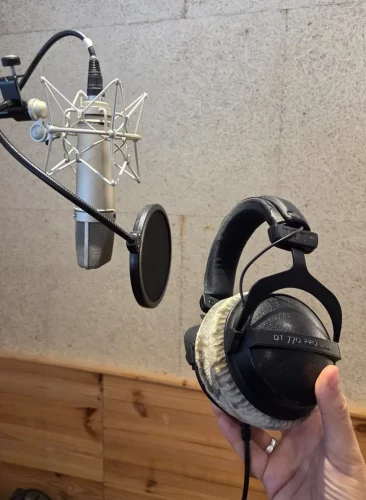
The 770 Pro from German manufacturer Beyerdynamic are one of today’s standards in recording booths all over the world. As a closed-back headphone with pretty solid isolation, the recording booth (if you have one) is its natural habitat for tracking and keeping the click or reference you listen to while recording from bleeding into the home studio microphone. For years now, this is the closed-back model we use for recording vocals and instruments in our recording studio.
The sound of these cans isn’t as precise as other more open options for mixing, but our take is that they’re well balanced frequency-wise, and their strong point is that they close up properly so the backing track doesn’t bleed into the mic, with more than enough quality to make quick decisions that you can later review using your studio monitors or another pair of headphones for the mixing process.
We especially recommend the 250 ohm version, which is the exact closed-back model we use in our studio and, in our opinion, the one that delivers the cleanest, most detailed sound of the three. It’s ideal if you work with an with a decent built-in headphone amp (standard in pretty much every modern home studio interface). There’s also a 32 ohm version, perfect if you don’t have a dedicated headphone amp, since it delivers loud, clear volume straight from your phone, computer or any entry-level interface, with no need to spend on external amplification.
- Frequency response: 5 – 35,000 Hz
- Cable length: 1.6 m (not swappable without taking them apart)
- Sensitivity: 96 dB/SPL
- Weight with cable: 317 g
- Carrying pouch included
4. Beyerdynamic DT 880 and DT 990 Pro (semi-open and open-back)

The DT 880 and DT 990 from Beyerdynamic are among the best headphones we’ve tested for making EQ decisions, monitoring and handling mixing tasks. With a fairly flat frequency response and a good low-end response, they’re perfect for any kind of mixing work.
The DT 880 are semi-open: they strike a balance between the comfort and sound of open-back headphones, but with less risk of sound bleeding into the room mics (even so, they’re not really recommended for recording unless you keep the volume very low). The 880 in their 250 ohm version are a really good pro option if you work with a decent headphone amp (at minimum the one included in any external audio interface) or a dedicated monitor/headphone distributor.
The DT 990 Pro are fully open-back, with a wider stereo image and a slightly more pronounced top end, which makes them really useful for fine-tuning reverbs, delays and space details in the mix. They’re usually more affordable than the 880, so they’re also a great entry point to the Beyerdynamic sound.
They’re very comfortable, durable, and their sound is pleasant for long studio sessions. In our opinion, the Beyerdynamic DT 880 and DT 990 are among the best options in their price range for precise studio work like mixing or mastering.
Along with the closed-back 770s from Beyer, the DT 880 Pro 250 Ω are the semi-open model we use for monitoring in our studio, and even though in our online mixing and mastering service we always use flat-response monitors, this model is what we use to double-check productions before delivery. The 250 ohm version gives a cleaner, more detailed sound than the 80 Ω version; it needs a bit more power, but you’ll have enough with the output or headphone amp on your audio interface.
More specs of the DT 880 Pro (250 ohm):
- SPL: 96 dB
- Frequency range: 5 – 35,000 Hz
- Weight: 290 g
- 3-meter cable (not swappable without taking them apart)
5. Sennheiser HD-25 (closed-back headphones)

The iconic HD25 from Sennheiser are some of the most used headphones by musicians for years now — producers, players and DJs all over the world. They’re closed-back but on-ear (they sit on top of the ear). With a powerful, reliable sound and an impedance of 70 ohms (plenty for any kind of amp), they’ve become one of the favorite cans for live musicians (very common for drummers and DJs on stage) and for monitoring and checking mixes in pro studios.
You won’t get the flattest possible sound for mixing, but they stand out for their very light weight (just 140 grams), sturdiness and durability.
More specs of the Sennheiser HD25:
- Max. SPL: 120 dB
- Frequency response: 16 – 22,000 Hz
- Detachable 1.5 m cable
- Weight: 140 g
Extra: 6. Rode NTH-100 (closed-back studio headphones)

We’re adding to the list one of the most widely used studio headphones right now, known for their sturdy build, flexibility with a detachable cable, and an ergonomic design built for comfort in pro and home studio settings.
The Rode NTH-100 have become one of the most popular alternatives in studio headphones, going head to head with iconic brands like Beyerdynamic and Audio-Technica. These closed-back, over-ear headphones deliver excellent clarity and sonic precision, perfect for monitoring and mixing tasks. Plus, comfort is guaranteed thanks to the memory foam pads with cooling gel, ideal for long work sessions.
More specs of the Rode NTH-100:
- Impedance: 32 ohms
- Max SPL: 110 dB
- Frequency response: 5 – 35,000 Hz
- Total harmonic distortion: <0.03% at 1 kHz
- Weight: 350 g
- Detachable 2.4 m cable
- Cooling gel pads for extra comfort
Extra: 7. Sony MDR-7506 (closed-back studio headphones)
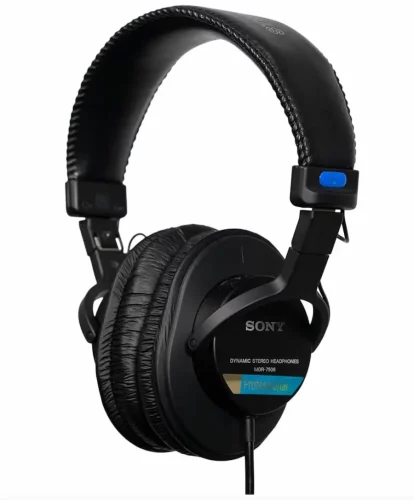
A classic in the industry and probably the best value-for-money option to start out with. They hover around €100 and have been a reference in studios and recording sets since the 90s.
They’re truly closed-back: they isolate well from outside noise and barely leak any sound out, so they work perfectly for recording vocals or instruments with open mics in the same room (many headphones sold as closed-back leak a lot; these don’t). Their sound has punchy lows and bright, detailed highs, with slightly scooped low-mids that help vocal intelligibility. They’re not the flattest on the market and that’s why we wouldn’t recommend them as your main cans for critical mixing or mastering, but for monitoring, tracking and having a solid, reliable pair of headphones in the studio, they’re one of the best investments you can make when you’re starting out.
More specs of the Sony MDR-7506:
- Closed-back, over-ear design
- Impedance: 63 ohm
- Frequency response: 10 – 20,000 Hz
- SPL: 106 dB
- Coiled 1.2 m cable (non-detachable)
- 6.3 mm jack adapter and carrying pouch included
- Weight: 298 g
Recommended software and plugins for mixing with studio headphones
- Compared to speakers, headphones often sound too wide, as if a chunk of the center of the stereo image were missing. To help with this, there are plugins like CanOpener Studio by Goodhertz, which lets you control this aspect and other headphone-related issues very precisely.
- Another issue is that headphones often have irregular, exaggerated or unnatural frequency response curves, either because they were designed that way or because they lack the natural low-end reinforcement you’d get in a real room with speakers. There are several plugins that simulate control rooms to use with headphones. For example, Sienna by Acustica Audio.
- As for the frequency response curve, at GuitarRec we use a corrective plugin (mainly for the monitor room) that also includes presets for balancing the frequency response of the main headphone models. The plugin is Sonarworks SoundID Reference (room measurement mic included), or if you’d rather not use a plugin inside the DAW you can also use the IK Multimedia ARC Studio hardware system for similar corrective results in your room.
One last thing: watch out for the cable 😉 and take care of your ears by keeping the volume moderate (hearing loss is a serious, irreversible issue!). Hope you enjoy recording and mixing music with whichever ones you pick.
You might also like: check out all our articles and tutorials on home studio gear.
*This article contains affiliate links that help us keep the site running. Don’t worry: the price you pay is the same! If you buy something through these links, we’ll get a small commission. Thanks for your support!

Article written by Vicen Martínez, music producer, guitarist, and songwriter. Founder of GuitarRec – Online Recording Studio.