

5 Mistakes You’re Making When Recording Guitars (And Tips to Avoid Them)
After years recording guitars for hundreds of productions, we’ve made (and seen others make) these mistakes far too many times. If you record guitars — whether at home or in a professional studio — or if you’re producing a track and coordinating or hiring a guitar recording session for your song, this article will save you hours of frustration and more than one forced re-recording. Here’s a list of the most common mistakes when recording guitars, both electric and acoustic. Some are obvious but need to be remembered in every session, and others you may not have even considered yet — plus how to avoid them and improve the sound of your guitar tracks in your production.
1. Not Tuning the Guitar Before Every Take
It seems obvious, but it’s not so obvious when you’ve been recording for six hours.
Here’s what happens: with your studio headphones on, fully immersed in the performance, your ears get fatigued and stop detecting small tuning issues. You record a take that feels perfect. The next day you listen back with fresh ears and… it’s out of tune. And if the performance was good, it hurts to have to re-record it. That’s the smallest problem, though — if you’re sending those guitar tracks to someone producing or mixing the song and they ask you to re-record them, that’s a feeling I can assure you you don’t want to experience.
The solution is simple but requires discipline: use a tuner before every take. Not every three takes. Every take. It doesn’t matter if you think it sounds fine. Tune, record, check tuning, record. It’s a habit that saves you from re-recording entire sessions. And ideally, use a physical pedal tuner, since a plugin tuner may not detect the signal as accurately (being inside the software and interrupting playback). A pedal tuner sits at the beginning of your signal chain, right after the guitar jack, and lets you mute your signal at any time without disturbing or interrupting playback.
Be careful with clip-on tuners as well. Although they’re a good home studio gadget, their limited accuracy means they’re only suitable for a quick check. Line tuners are always more precise.
2. Not Choosing the Right Guitar Sound Before Recording
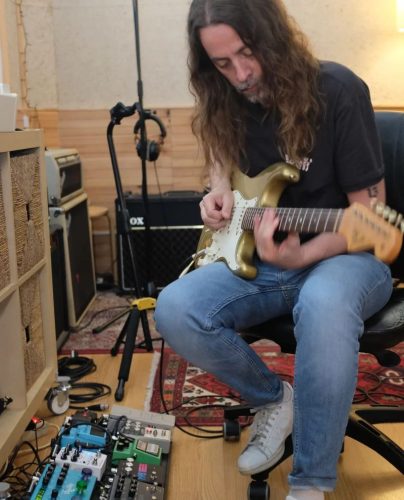
Another classic: you plug in, find a sound that “kind of works,” and start recording. The problem comes later, when you have an amazing performance but a tone that doesn’t fully fit what you were aiming for in the production.
There are options like reamping or recording DI and processing later, but if the performance was truly good, you won’t always have enough flexibility to reshape the sound as much as you need without losing what made it special. We can assure you that all the time spent before recording — dialing in your guitar tone, even searching for reference tracks — is vital to guide that performance. Once you’ve defined the tone, you can adjust it slightly, add more or less distortion, but the performance itself will already be shaped around that intentional sound.
Take time before recording to test sounds, adjust the amp or emulation, and make sure what you’re hearing through the monitors is exactly what you want in the song. Those 20 minutes of preparation can save you hours of frustration during mixing. This is where having good guitarist equipment makes all the difference.3. Overproducing: Doubling Guitars to Cover a Weak Tone
I know this one well because I’ve been there. When I used to record in my home studio — before building our recording studio in Barcelona — I used guitar amp emulation software like Guitar Rig and whatever was available to record DI. The sound always felt slightly thin, slightly lacking body. The solution? Double it. Triple it. Add another layer. And another. You end up with eight guitar tracks just to achieve the thickness that two or three well-recorded tracks would give you effortlessly.
When you start recording with a good amp — or even with today’s high-quality emulations — you realize you need far fewer tracks. One great-sounding guitar fills more space than three mediocre ones.
The mistake isn’t doubling guitars (sometimes it’s exactly what the song needs and it’s an excellent way to widen the stereo image). The mistake is doubling out of necessity — to cover up a tone you’re not happy with — instead of doubling as a creative decision.
4. Recording Guitars with Too Many (or Too Few) Effects
This point has two sides: overusing effects, but also using too little.
We’re in favor of recording with effects. A well-chosen delay or reverb can inspire a better performance and, above all, guide the production. Recording with effects is a way of making creative decisions as the process moves forward instead of leaving everything for the mixing stage.
There’s an important nuance here: when you use effects like a distortion pedal, and other effects like reverb and delay before the amp simulation or tube amplifier, those overdrives, reverbs, and delays become much more integrated into the sound than when you add a plugin effect afterward. It’s a subtle difference, but it’s noticeable in how cohesive and compact the final guitar track sounds.
That said, there’s a fine line between recording with character and recording yourself into a corner. If you drench a guitar in reverb and delay, that’s permanently printed on the track, and you won’t be able to remove it in the mix. If you’re unsure, record a clean signal in parallel so you get the best of both worlds.
In our online guitar recording service, the producers and mix engineers who receive our tracks appreciate that the guitars arrive ready to drag and drop, with the effects already included and the sonic concept developed (almost mixed already). This makes the mix engineer’s job much easier, avoids misunderstandings about how the guitar should sound in the track, and delivers a clear direction from the start.
There are also clients who ask for the tracks without effects, but they’re usually less experienced producers. More seasoned producers know it’s better for the guitarist to make tonal decisions and guide the direction with references before recording.
5. Mixing Two Guitar Microphones Without Experience
Just like with effects, this is the most technical mistake we encounter when recording guitars: not everyone knows how to blend two microphones on a guitar amplifier (no matter how good the take, guitar, effects, mic, or preamps are). You need to know what you’re aiming for when pre-mixing those mics, taking into account factors like phase, EQ, unnecessary frequencies, and where that track will sit in the stereo image of the professional music production. A guitar amplifier isn’t easy to tame in terms of frequency control.
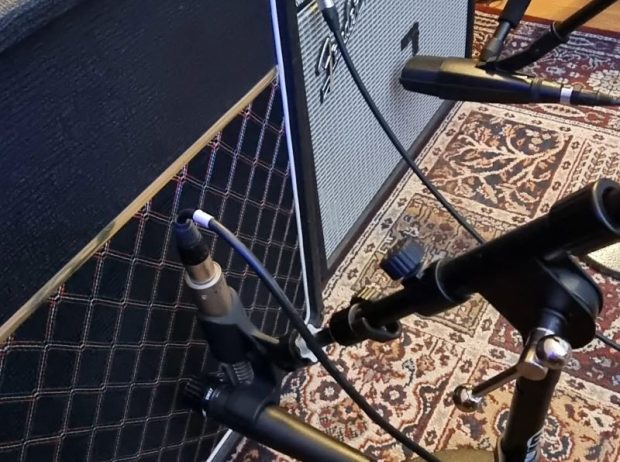
When you record an electric guitar with a good amp and two microphones — as we do in our studio using API preamps and high-quality microphones (Royer 121 ribbon, Shure SM57 for electrics, and Neumann U87, KM184 and AKG 414 B-ULS for acoustics) — the raw result doesn’t sound bad; it simply requires technical knowledge and experience blending guitar mics to achieve the sound you’re after and get there by filtering unnecessary frequencies.
It has happened to us: we send RAW tracks to a producer and they think something went wrong. Nothing went wrong — blending multiple guitar microphones isn’t trivial. If you’re recording with more than one mic, make sure you understand phase, dynamic EQ, and balance to create a coherent track for each guitar. One of the best tips for recording guitars in the studio is simplifying the mix by groups or audio stems as you go, instead of accumulating raw tracks that later become difficult to integrate into the mix.
That’s why in our recordings we now always send guitars with the mic tracks already pre-mixed, with some light EQ and compression (very subtle), so the producer receives a guided sound with room for adjustment and ready to integrate into their mix.
Conclusion and Final Tips for Recording Guitars
All these mistakes have something in common: not being clear about which stage of the music production process you’re in. Creating is not the same as defining.
If you’re in an early stage of professional music production — in pre-production — it’s better to prioritize the creative side: let ideas flow, try different sounds, experiment without fear of making mistakes. At that point, recording in your home studio at home, technical perfection matters less than inspiration. Although it’s always important to keep in mind that any of these guitar recordings may end up staying in the final mix.
But when you reach the final recording stage, everything changes. At that point, you need to make sure both the performance and the tone are technically solid for the mix. Spot-on tuning, a well-chosen sound, intentional use of effects, and tracks prepared so the mix flows smoothly.
Knowing which stage you’re in is what separates a professional guitar recording from one that “kind of works.”
I hope these guitar recording tips help you — whether you’re a guitarist or producing other guitarists and need the guitars in your track to sound as good as possible. Avoid these recording mistakes and, most importantly, enjoy the process and learn from every session.

Article written by Vicen Martínez, music producer, guitarist, and songwriter. Founder of GuitarRec – Online Recording Studio.