

5 Essential Distortion and Overdrive pedals
The electric guitar is a versatile instrument offering a world of sonic possibilities, especially when paired with the right effect pedals. At the heart of this sonic exploration with the guitar are distortion, overdrive, and fuzz pedals, essential tools for any guitarist who wants to experience the characteristic sounds of a cranked amplifier (and much more…). From a soft overdrive that adds warmth and body to the sound, a powerful and raw distortion for your song’s main riff, to a searing fuzz for your solo.
As a studio specialized in online guitar recording, we present a selection of the best overdrive and distortion pedals we think every guitarist should have, along with some affordable alternatives. These pedals are part of music history and are indispensable for the quest for the perfect tone or emulating the sound of classic albums that have paved the way for guitarists. They will provide hours of fun, and each, due to its characteristics, drive type, color, and distortion, will take you to different places when composing melodies, riffs, and solos with your electric guitar.
Guitar Pedals: Use and Possibilities

Analog guitar pedals have long been, and remain, the favorites of many guitarists. They offer a warm and characteristic sound, recognizable and used in countless recordings, with a dynamic response that changes depending on how you play the strings of your electric guitar. Analog distortion or overdrive pedals, built with electronic components such as transistors, resistors, and capacitors, like the Tube Screamer and the Pro Co RAT, have left a mark on music history.
Guitar Pedals vs Multi-effects Pedals
The choice between equipping yourself with a pedalboard with individual effect pedals and a digital multi-effects pedalboard largely depends on the musician’s style, the need for versatility, and personal preference regarding sound quality and aesthetics. While some guitarists prefer the authenticity and simplicity of analog pedals, with the craftsmanship involved in connecting pedals, cabling, building a pedalboard, and manually modifying the order, others opt for the convenience and diversity of all-in-one digital emulation options using digital multi-effect pedalboards.

Each option undoubtedly has its pros and cons, and either path will serve you well for creative tasks like songwriting with your instrument, recording in the studio, or performing live with your band. A way to summarize it would be that the path of effect pedals is one of aesthetics and the purest sound, while multi-effects or digital emulation is the most practical and versatile.
And while one of the most common mistakes when recording guitars is not spending enough time getting the perfect tone for that take, nowadays with both systems you can achieve professional guitar sounds. It can be likened to choosing between a real tube amplifier system or a digitally emulated amplifier simulator using impulses, like the Kemper Profiler. Let’s not forget about the arsenal of free plugins we can find, offering amplifier and distortion effect simulators to use with our DAW or music production software.
Distortion, Overdrive, and Fuzz Pedals: Uses and Differences
Before diving into specific recommendations for the most-used distortion pedals, it’s crucial to understand the differences and practical applications of distortion, overdrive, and fuzz pedals, as this article features several of the best guitar pedal types from each of these effect categories.
What Does an Overdrive Pedal Do?

The overdrive gently increases gain, emulating the saturation naturally produced in tube amplifiers. This type of pedal is used across all genres derived from blues, rock, indie, and alternative music, offering a warm and natural sound that can approach distortion levels depending on the gain used.
What Does a Distortion Pedal Do?
Distortion pedals provide a more intense and aggressive effect, producing a heavier and saturated tone (or “crunchy” as some might describe it). They are a top choice for hard rock and metal genres, delivering a powerful and defined sound. However, like other pedal types, they are now used by guitarists of all styles. With moderate gain or volume levels, they can offer warm tones closer to overdrive pedals.
What Does a Fuzz Pedal Do?
The fuzz pedal produces a raw, psychedelic sound, extremely distorting the signal. Popular in the rock of the ’60s and ’70s and now used by indie/psychedelic bands like Tame Impala, it’s ideal for those seeking a vintage tone or experimenting with heavier sounds. Think of the iconic guitar sound in the wildest parts of Jimi Hendrix’s songs.
The 5 Must-Have Distortion and Overdrive Pedals for Guitar
Now, let’s explore the five essential types of distortion and overdrive pedals, each with unique features, recommended current options, and affordable alternatives to these classic electric guitar pedals.
1. Tube Screamer-Type Overdrive Pedal

This analog-circuit guitar pedal, perhaps one of the most classic for distorting guitar sounds, is known for its ability to add a warm and smooth overdrive, ideal for all styles but indispensable for blues and classic rock. Its sound has been a key component in the gear of numerous famous guitarists for decades. Most notably, Stevie Ray Vaughan was always associated with the sound of this pedal.
The original versions of this pedal were made by Ibanez (TS-808 and TS-9 models), although there are many Tube Screamer versions today, and many claim that Maxon’s current version, the OD-9, is the closest to the original in terms of components. In fact, the Maxon OD-9 is the exact pedal we use in our studio for recording guitars. Almost every guitar pedal brand offers its own “version” of the Tube Screamer. Affordable options include pedals that emulate its classic sound while maintaining its characteristic tone essence.
2. Pro Co RAT-Type Distortion Pedal

The Pro Co RAT is an analog distortion pedal for guitar with an aggressive, sharp, and versatile sound, perfect for genres requiring heavier tones. This pedal offers a wide range of tones, from mild overdrive to intense distortion nearing fuzz. As an “image,” it’s the only pedal visibly used in the video of the iconic song Song 2 by Blur (you can probably already imagine the sound). It has also been used by numerous guitarists from legendary hard rock bands of the late ’80s and ’90s. Undoubtedly, a distortion pedal of this type should be a staple in your pedalboard, regardless of your style.
3. Klon Centaur-Type Overdrive/Booster Pedal

The Klon Centaur is revered for its transparency and ability to add warm, rich overdrive without drastically altering the guitar’s original tone. This iconic pedal enhances the mid frequencies of the guitar’s sound, simulating a high-volume tube amplifier. This has made it one of the must-have distortion pedals for single-coil guitar users (like Fender Stratocasters and Telecasters), as it adds extra gain and thickness to the sound. With low gain settings, it’s often left on as a base clean sound, providing a more robust clean tone. It’s a staple in the pedalboards of great guitarists like John Mayer.
Affordable Klon Centaur Overdrive Pedal Alternatives
Since the original Klon Centaur pedal is currently only within the reach of collectors and is very hard to find (asking prices usually range from €5,000 to €10,000), there are many alternatives on the market based on its circuit that attempt to capture its unique sound. In our studio, we are lucky to have the Klon KTR, the official reissue designed by the original creator, but since it is unfortunately also discontinued, here we leave you some of the best options available today. Without a doubt, this is one of the essential pedals in your guitar arsenal, especially if you use Stratocaster-style guitars, to give it that gain push that you can leave on for the entire performance.
Wampler Tumnus – Check price on Thomann – Check price on Amazon.com
Electro Harmonix Soul Food – Check price on Thomann – Check price on Amazon.com
4. Boss DS-1-Type Distortion Pedal

A classic, the Boss DS-1 analog distortion pedal is known for its straightforward and powerful sound, being a favorite for decades among many rock band guitarists. Since its release in 1978, countless classic riffs have been written and recorded using this pedal. It’s used by amateur guitarists and professional session guitarists across all styles. Iconic guitarists like John Frusciante, Kurt Cobain, and Steve Vai have all used the best-selling pedal from this legendary guitar pedal brand: Boss. Undoubtedly, it’s an option to consider if you’re looking for a good distortion pedal at a relatively moderate price compared to some alternatives. Below are links, including the Boss SD1 overdrive pedal, if you’re looking for a softer distortion.
5. Dual Overdrive or Distortion Pedals, Like Strymon Riverside or Sunset

Using two pedals in series for distortion or overdrive allows you to have three different sounds on your pedalboard: each one separately, and the combination of both. There have always been pedals offering this capability. The Riverside by Strymon, a company that has risen to the top of guitar pedal manufacturers in recent years, provides incredible versatility with its two digitally emulated drive channels. It’s ideal for musicians seeking a wide range of sounds, from smooth overdrive to saturated distortion. We can assure you it’s a great professional option, as we use it in our online music productions. Its dynamics and tone make it hard to believe it’s a digital overdrive pedal.
Like the rest of Strymon’s lineup, this is a more premium option than the alternatives mentioned earlier, but its quality and versatility justify the price. The dual Sunset pedal is also available if you’re looking for more distorted tones.
6. (Extra) Analog Fuzz Pedals (Germanium and Silicon)

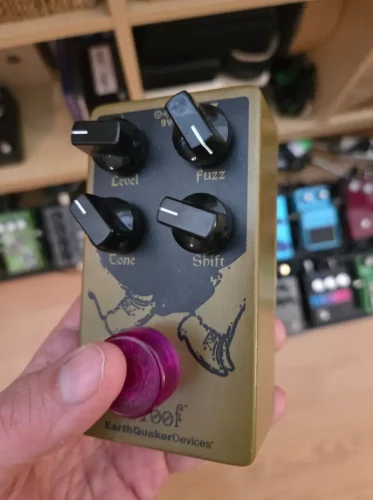
Fuzz pedals with germanium and silicon transistors (key electronic components affecting how the signal is amplified and distorted) offer unique textures, essential for creating heavily distorted guitar sounds with psychedelic and vintage vibes. The Germanium Fuzz, such as the iconic Fuzz Face now produced by Dunlop, is known for its warm and smooth tone, famously used by Jimi Hendrix to achieve his characteristic sound. On the other hand, the Big Muff by Electro-Harmonix, a fuzz pedal more commonly associated with silicon transistors, provides a brighter and more aggressive tone.
This difference in transistor type results in a variety of tonal textures, with the Fuzz Face offering a classic and expressive sound, while the Big Muff delivers denser and more sustained distortion. Both types of fuzz pedals are essential in a guitarist’s tonal palette, enabling a broad range of sonic exploration.
In our pedalboard (alongside several other fuzz pedals), we use the EarthQuaker Devices Hoof v2 , which perfectly bridges both worlds. Featuring a hybrid germanium/silicon transistor circuit, it provides the exact sound and controls we need to adapt to any fuzz style required in our online productions. Thanks to its versatile controls (Tone, Shift, Level, and Fuzz), it can deliver everything from a dirty, amp-like overdrive to a monstrous fuzz.
Other Distortion Pedals Worth Mentioning and Conclusion
If you’re passionate about guitar pedals, or enjoy using these pedals with other instruments like bass, synthesizers, keyboards, etc., the list of must-haves is endless (and trust us, it grows every year). We’ve left many out of this article, but to name a few more must-have overdrive and distortion pedals: Fulltone OCD, Xotic BB Preamp, Blues Driver and Metal Zone by Boss, MXR Distortion+, Zvex Box of Rock, and a very long etcetera.
We hope this information has been helpful, and at GuitarRec, we encourage you to dive into the world of guitar effects in pedal format, as they will provide hours and hours of entertainment, experimentation with your instrument, and, let’s be honest, they’ll visually brighten your life just by being in your shiny new pedalboard. 😉 Enjoy the process!
You might also be interested in: the best studio headphones for music production.
*This article contains affiliate links that help us maintain our site. Don’t worry: The price you pay is the same! If you purchase something through these links, we’ll receive a small commission. Thank you for your support!

Article written by Vicen Martínez, music producer, guitarist, and songwriter. Founder of GuitarRec – Online Recording Studio.