
How to pitch your song to spotify and get on editorial playlists
The almost obsessive goal of getting featured on Spotify editorial playlists is very common among independent (and not-so-independent) projects. At GuitarRec studio we want to help you understand how this process works, how to make a great pitch, and what you can really expect from playlists like Novedades Indie or Fresh Finds España.
In this updated tutorial, we’ll guide you step-by-step, bust some myths, share practical tips, show how many plays you can expect, and suggest how to pitch correctly on Spotify to increase your chances of success promoting your song on Spotify.
We’ll draw from the recent experience of Tripulante, the project by Vicen Martínez (creator of GuitarRec), who managed to get three of his upcoming album’s singles featured in two major editorial playlists: Novedades Indie and Fresh Finds España. All this managed independently under his own label Keepalive Records.
What is a Spotify pitch?
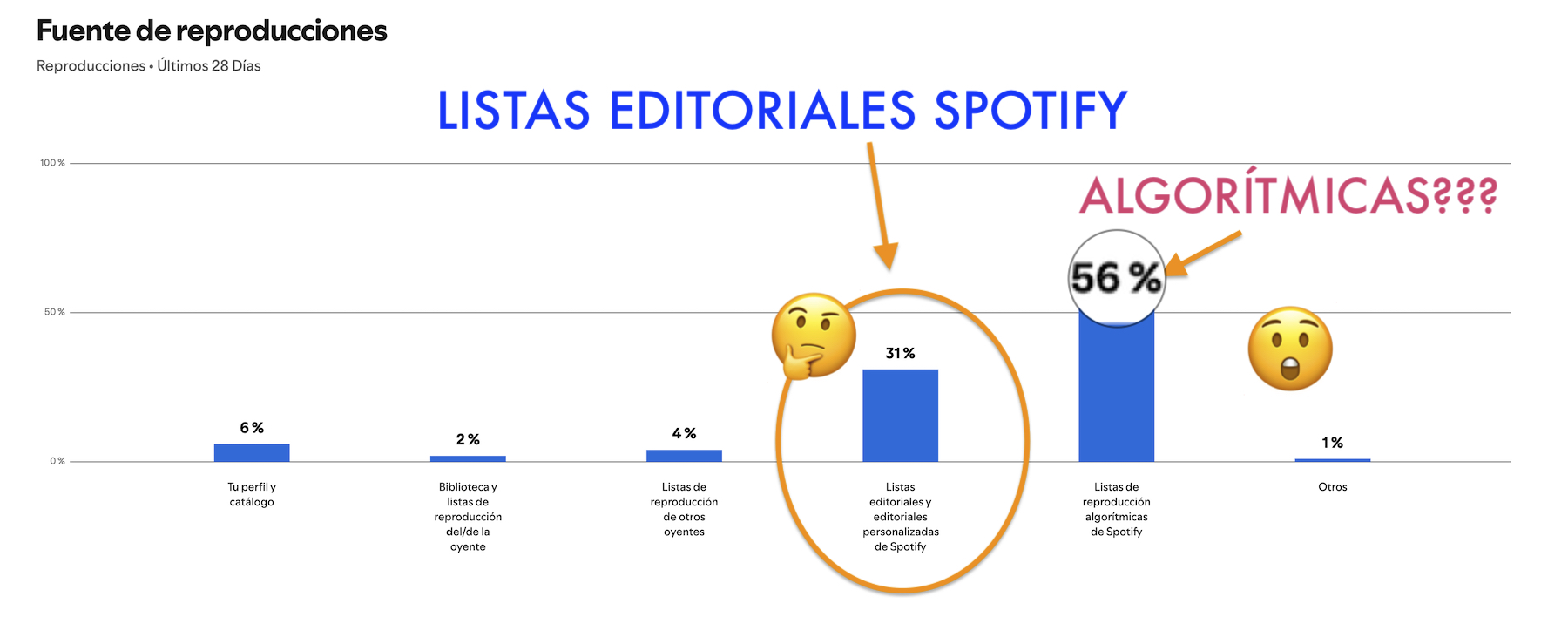
The pitch is a free tool that Spotify for Artists provides to musicians to submit an unreleased song to editorial playlist editors before its release. If done correctly, your track may end up on editorial playlists manually curated by the Spotify team or on personalized editorial playlists, where algorithms tailor the content based on each user’s tastes. We’ll explain the different types of playlists in detail later on.
Step-by-step guide to pitching on Spotify
1. Upload your song to Spotify in advance
The first requirement is simple: have the track uploaded on Spotify for Artists at least 2–3 weeks prior to the release date to be able to submit a pitch. This means you’ll need to initiate distribution with your digital distributor 30 to 40 days before the official date, as processing times, quality control, and features vary and usually take a few days.
2. Access Spotify for Artists
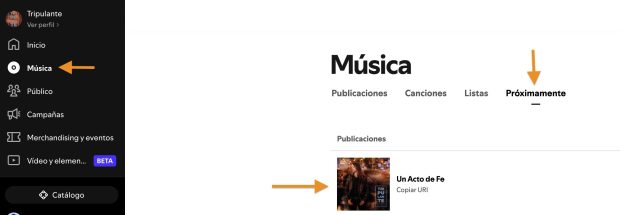
Go to your Spotify for Artists profile and head to the Music → Upcoming section. There you’ll find the Submit a Song button.
Good to know: if you already have a distributed song but don’t have Spotify for Artists, here’s a tutorial on how to access and set up an artist profile on Spotify for Artists.
3. Fill in all pitch information
This is where the key part begins:
- Select the music genre: you can choose up to three genres.
- Moods: choose the ones that best describe the song.
- Instrumentation: you can select from various instruments used in the music production.
- Culture: if applicable, although these are very specific (Christian, Arabic, etc…)
- Lyrics language (if applicable): essential.
- Description text: include the song’s mood, influences, the reason for the musical and production direction, next steps, whether more singles are planned, etc.
How to write a good pitch description
The text should explain the emotion conveyed by the song, the musical references, and the reasoning behind the production and artistic direction. It’s also useful to mention what promotional actions will accompany the release, if new singles are planned soon, upcoming releases, and upcoming concerts.
Undoubtedly, all the information about how to properly pitch on Spotify is a shot in the dark, and even if your song is selected for an editorial playlist, you’ll never know exactly what worked. Still, we like to believe that the personality when writing a song, the sound quality in production, your image as an artist, and your concept will be key for one of the curators to decide to include it in a Spotify editorial playlist.
Tips and best practices
✅ Submit the pitch at least 2–3 weeks before release. Although our single Actuar was featured in Novedades Indie with just 10 days’ notice, we recommend at least 2–3 weeks to maximize your chances.
✅ Be honest with your pitch. Describe your music and your actual plans without exaggerating.
✅ Combine the pitch with external promotion. Social media, niche media, TikTok, press campaigns, etc.
✅ Consider your song’s structure. While we shouldn’t follow trends blindly, it’s true that short songs are performing better on streaming platforms. Try to ensure that the structure of the song you choose to pitch on Spotify is clear and direct and doesn’t take too long to reach the vocals. (Tip: if your song has a very long intro, consider splitting it as a separate track.)
✅ Do it for every release. There’s no magic formula: each song has its own chance. Also, it’s recommended to release new songs every 4–5 weeks. In Tripulante’s case, this consistency has aligned with continued playlist presence, which could be a key factor for curators to see strength and commitment in the project.
✅ Remember: you can only submit one pitch per release. If you’re releasing an EP or full album, you’ll need to select a single track for editorial playlist consideration. Once a single is released, you won’t be able to pitch it again even if it’s included in a new album.
Spotify pitch myths and legends
- Myth 1: “You need to submit the pitch a month or more in advance.”
→ Reality: While 2–3 weeks is advised, Actuar got into an editorial playlist with 300k followers after submitting the pitch just 10 days in advance. - Myth 2: “If you don’t have a big label, you don’t stand a chance.”
→ Reality: Playlists like Fresh Finds are specifically looking for independent artists. - Myth 3: “Getting into editorial playlists guarantees thousands of streams.”
→ Reality: The stream boost is usually moderate, but it’s key for visibility, exposure in the industry and to new users, projection, external communication, and of course, the personal boost it gives the artist.
Types of editorial playlists on Spotify
Spotify classifies its playlists into three main categories, each with different functions and purposes. The editorial and personalized editorial playlists are the ones you target when submitting a pitch.
Editorial playlists
These playlists are manually created and ordered by Spotify’s editorial team. Their goal is to spotlight new releases, emerging artists, and musical trends. All listeners see the same content in the same order. Examples include: Novedades Indie, Fresh Finds España, Novedades Rock, EQUAL, New Music Friday, Radar de Novedades, Pop Rising, Rock This, mint, Baila Reggaetón, Viva Latino, among others.
Personalized editorial playlists
In these playlists, editors select a base set of songs, but algorithms personalize which tracks are shown to each listener based on their tastes and listening habits. Examples include: Radar Indie, Radar España, Acústicas. These are essential for tailoring releases to specific audiences.
Pure algorithmic playlists
These playlists are generated exclusively by algorithms and are based on each user’s individual behavior. Some of the most notable ones include:
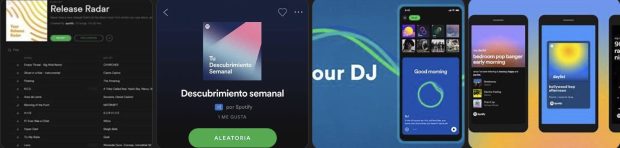
- Release Radar: Features new releases from artists you follow or that Spotify deems relevant to you. It’s fully algorithmic and requires your pitch to be submitted at least one week before release for your song to appear.
- Discover Weekly: Every Monday, it offers a personalized selection based on your preferences and recent listening.
- Artist or song radio: Creates a continuous playback session based on a specific track or artist, aiming for sonic compatibility.
- Your DJ: An assistant that mixes personalized recommendations with spoken intros.
- Smart Shuffle: Suggests new songs while you play one of your own playlists in shuffle mode.
- Daylist: A dynamic playlist that changes throughout the day based on your listening behavior.
- Personalized mixes: Such as Your Daily Mix, Indie Mix, Rock Mix, On Repeat, Feel-Good Hits, and others that blend your favorite genres and artists.
These playlists are essential for maintaining organic growth and connecting with new listeners, even without editorial intervention.
How many streams do official editorial playlists generate?
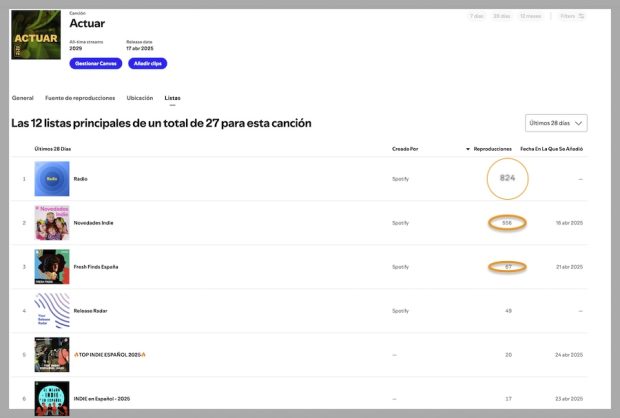
As shown in the image, for the fourth single from the album by Tripulante, Actuar, the song entered Novedades Indie (556 streams, a playlist with approximately 300,000 listeners) and Fresh Finds España (67 streams, a playlist with about 15,000 listeners), ranking around position 30 in both editorial playlists and staying for one week. Meanwhile, the algorithmic playlist Radio generated 824 streams (around 200 per week, and even more in the weeks following its playlist inclusion).
This confirms that:
✔ Editorial playlists are key for visibility and external communication.
✔ Algorithmic playlists (like Radio) can generate more sustained streams.
✔ The main goal should not be just accumulating streams, but combining playlists with a global promotion strategy, and perhaps not focusing solely on getting into editorial playlists.
La forma más fácil de conseguir el resultado profesional que buscas en la producción musical de tus canciones
Do you have to pay to appear on Spotify’s editorial playlists?
No, Spotify does not charge to include songs in its editorial playlists. The official process to be considered is through the pitch feature in Spotify for Artists, and it is free. However, there are other services and external curators that offer playlist placement in exchange for money. It’s important to be cautious, as many of these services use questionable practices, such as bots, which can harm your profile and lead to your music being removed from the platform. Additionally, Spotify explicitly prohibits paying for inclusion in its official playlists and may take action against those who violate this policy.
What is Spotify’s Discovery Mode and how does it work?
Spotify’s Discovery Mode is a promotional tool that allows artists and labels to increase the visibility of selected songs in algorithmic recommendations, such as Radio and Autoplay, in exchange for accepting a reduced royalty rate for those streams. To access it, certain requirements must be met: at least 3 eligible songs, a minimum of 25,000 monthly listeners, working with a participating distributor, and meeting Spotify’s minimum activity criteria. Songs must have been released at least 30 days prior and have already accumulated streams in algorithmic contexts. Remember that you also have the option to promote your songs using Spotify’s Showcase and Marquee tools.
Although Spotify does not disclose the exact percentage of the royalty reduction, industry sources estimate it to be around 30%. Discovery Mode does not require direct payments or signing any music contracts, but artists must assess whether the increase in exposure is worth the drop in per-stream income. The tool has sparked debate within the industry, with some viewing it as a form of “algorithmic payola,” while others see it as an opportunity to boost organic growth on the platform.
User-created playlists (or by record labels…)
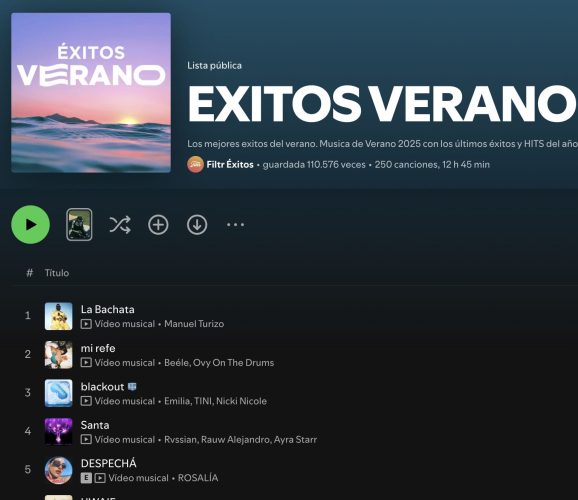
User-created playlists are a fundamental part of Spotify’s ecosystem. Nearly all record labels, indie labels, and artists have their own playlists with hundreds of thousands of followers, or they hire specialized companies that act as direct promotion channels for their releases. (Example: Filtr Éxitos = Sony Music). Without a doubt, this is one of the main ways to promote your music on Spotify.
There are also independent curators who manage very powerful playlists, some with thousands or even millions of followers. In many cases, these curators may offer to include your track in their playlists in exchange for a budget that covers their selection, curation, and promotion work, including campaigns on Meta (Facebook and Instagram Ads) or other platforms to boost their playlists’ reach —which, indirectly, also benefits us as featured artists.
It’s important to distinguish between legitimate collaboration agreements (where payment is for work and advertising visibility) and fraudulent practices that promise “followers” or “guaranteed streams” using bots. This is increasingly penalized and tracked by Spotify and may result in the removal of your songs or entire catalog.
Conclusion: Combine pitch, promotion, and authenticity
Getting featured on editorial playlists is a great tool for growth, but it’s not the only one. At GuitarRec, we encourage you to:
- Submit a well-crafted pitch on Spotify for each release.
- Complement with social media campaigns, press, and audiovisual content.
- Maintain close communication with your audience, since there are many success stories with millions of streams on Spotify that fail to channel that audience toward their social networks or build a solid community.
We hope this music marketing article help you continue promoting your music and building a solid and authentic project over time.

Article written by Vicen Martínez, music producer, guitarist, and songwriter. Founder of GuitarRec – Online Recording Studio.