

Spotify Showcase vs Marquee: Do They Work for Promoting Your Music?
Promoting music on Spotify is one of the main concerns for independent artists and producers today. With millions of songs uploaded every month, standing out requires not just good music, but also effective marketing strategies. Two of the paid tools that Spotify offers to boost releases are Marquee and Showcase.
But are they really useful? Or are there better ways to invest your money? In this analysis from GuitarRec Studio, we explore how they work, their requirements, real-world results, and whether they are really worth it for a developing artist.
What are Spotify Marquee and Showcase?
Spotify Marquee is a sponsored notification (pop-up) that appears in the Spotify app when you release new music and is shown to your most engaged listeners. Its goal is to quickly drive plays, especially among those who have already listened to or followed your music.
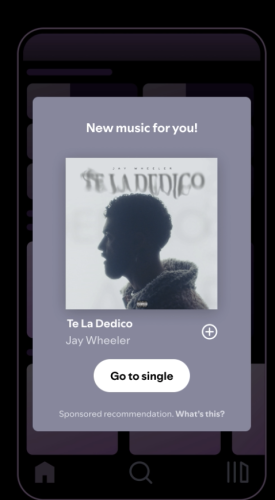
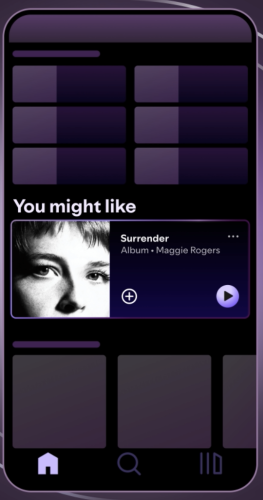
Showcase, on the other hand, is a visual card that appears on the “Home” section of Spotify and is used to highlight a release, even to less frequent listeners. Showcase aims to catch the attention of users who might not follow you yet, generating more reach and visibility.
The minimum price for Showcase in Europe is €90 (or $100 in the US), with an approximate cost per click of €0.27, meaning that with this minimum you can get around 330 clicks.
Currently, these campaigns are only available in certain countries (like the US, Canada, UK, Australia, Spain, and some other European and Latin American markets). Additionally, to use Marquee you need at least 2,500 active monthly listeners in the country where you want to promote, while Showcase is less restrictive and more accessible for emerging artists.
Among other requirements, the release for Marquee must be recent (less than 18 days old), contain at least 50% new tracks, and pass Spotify’s moderation process. The main artist must be the one promoting, and all files must be properly uploaded.
How do Marquee and Showcase work?
Once you access your Spotify for Artists account and can edit your artist profile on Spotify, you can configure these campaigns by selecting the release you want to promote, the budget, and your target audience.
One of the main advantages of Showcase is that it allows for more detailed audience segmentation. You can customize it based on:
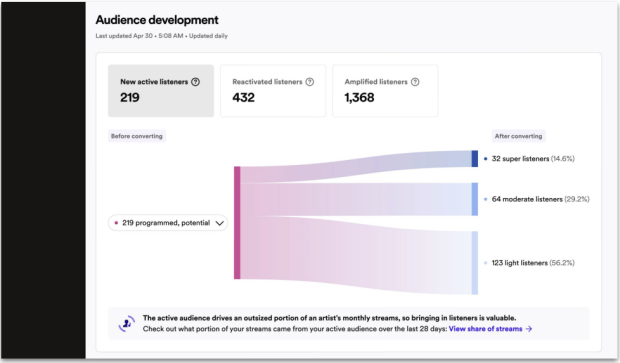
- Active audience, subdivided into super listeners, moderate listeners, and occasional listeners.
- Previously active audience, which includes listeners who used to listen to you but have been inactive in the past 28 days.
- Programmed audience, listeners who have only heard your music through editorial playlists or algorithmic playlists.
If you don’t choose advanced segmentation, the campaign will automatically optimize to reach those most likely to listen to your music.
According to Spotify, the key is to increase “listening depth” — meaning the listener not only hears the promoted track but also explores more of your catalog and eventually follows you.
You might be interested: how to add your song lyrics on Spotify (and make them appear automatically on Instagram and other networks)
Results and practical experience using them
In our experience with the indie pop-rock project Tripulante, we ran separate campaigns using Marquee and Showcase, investing €100 per campaign.
The actual results were as follows:
- Between 350 and 500 clicks per campaign, depending on segmentation and country.
- Approximately 1.5 plays per user.
- A 5–10% increase in monthly listeners.
- Save rate around 6% of total plays.
Although we did see a spike in streams and a bit more visibility during the campaigns, the truth is that the real impact on building community or gaining loyal followers was quite limited. Most people listen to the promoted track and that’s it — they don’t come back or explore the rest of the catalog. In short, these tools for promoting music on Spotify can work as a one-time push within a bigger launch strategy, but they’re not the foundation for sustainable growth or for building a solid fanbase… unless you have budget to run them constantly, of course, which we doubt!
Community opinions and experiences
We found mixed opinions about these marketing functions. Some artists appreciate the quick spike in streams and the chance to gain visibility directly on the platform without relying on external networks.
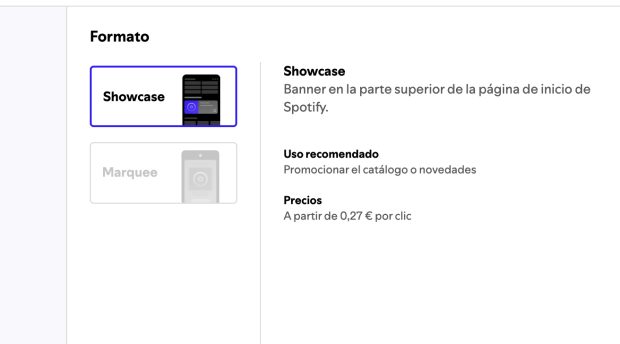
However, most agree that the cost per click (approx. €0.27–0.40) is high compared to ads on Instagram or TikTok, where you not only get more clicks and streams but also new followers and more interaction with your content.
Other artists point out that Showcase works better with albums or EPs, since there is more potential to engage the listener and increase “listening depth.” Some also report that the budget doesn’t always get fully spent because Spotify can’t find enough compatible listeners, especially if you have a small existing audience.
Additionally, many highlight that the real issue is that Spotify, with these tools, turns artists into paying customers for streams, ultimately benefiting the platform’s own business model. Although it’s natural, and the truth is it gives us handy tools to promote directly that were previously only available to the top music distributors or Meta Ads experts.
Pros and cons of promoting with Marquee and Showcase on Spotify
Pros
- Direct exposure on Spotify, no need to redirect listeners to other platforms.
- Easy to activate from Spotify for Artists.
- Useful option to boost major releases.
- Segmentation by country and listener type (reactivating super listeners, etc.).
Cons
- High cost per click.
- Does not always generate new followers or real engagement.
- Somewhat limited segmentation compared to social media ads (musical tastes, fans of other artists, etc.).
- Long-term impact is very reduced if not combined with other strategies.
Conclusion: is it worth investing in Marquee and Showcase?
If your goal is to quickly increase plays during a specific release and you have extra budget, Marquee and Showcase can be a useful complement to promote your music productions independently and without intermediaries. They work well as support when there’s already a solid plan with social media marketing, concerts, and constant content.
However, if your goal is to build a loyal fanbase and grow organically, your money is probably better invested in Instagram or TikTok campaigns, or even in consistent and authentic content creation on social media, where you can interact directly, tell your story, and turn the listener into a true fan.
In our case with Tripulante, although we saw positive results in plays and saves, the return in terms of community building was limited. These types of campaigns can work, but only if they are combined with other promotion methods, such as pitching on Spotify and promoting your music in every possible way to support the release and reach more people.
We hope this information helps you keep growing as an artist and build your fanbase. And don’t forget to subscribe to our newsletter below to receive more guides and in-depth analyses on music marketing and independent production straight to your inbox.
You might also be interested in: check out our article on how to fix a spotify content mismatch and request the separation of a duplicate artist profile on Spotify.

Article written by Vicen Martínez, music producer, guitarist, and songwriter. Founder of GuitarRec – Online Recording Studio.